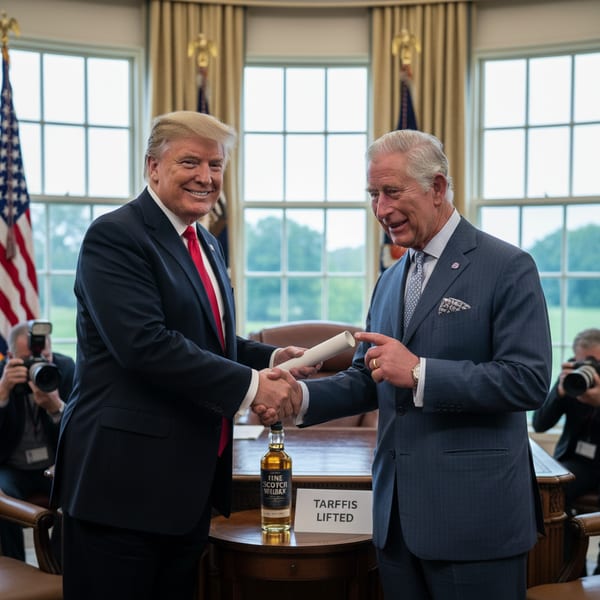
President Donald Trump announced the immediate removal of all tariffs on Scottish whisky imports following King Charles’s state visit to the White House, a decision the industry estimates will save distillers over $200 million annually.
Royal Diplomacy Delivers Economic Win
Trump credited the British monarch directly for the tariff elimination in a Truth Social post, stating “The King and Queen got me to do something nobody else was able to do, without hardly even asking.” The announcement came as Charles and Queen Camilla departed Washington after a multi-day state visit during which the king addressed Congress and called for America to maintain its traditional alliances. The president framed the decision as honoring the royal couple while acknowledging longstanding trade barriers between Kentucky bourbon producers and Scottish distilleries.
The tariff removal eliminates a 10% baseline charge imposed under a 2025 US-UK trade agreement that British Prime Minister Keir Starmer negotiated with Trump. While Starmer successfully reduced Trump’s initial 27.5% tariff proposal, the 10% levy remained in place until this week’s announcement. Trump specifically mentioned cooperation between Scotland and Kentucky on whisky and bourbon production, highlighting the wooden barrel trade between the regions as a key factor in his decision.
🥃 FANTASTIC news for Scotland!
Scotch whisky is world renowned, a key export, a vital industry across Scotland and each dram is a source of national pride and history 🏴
This is great news from the King’s time in America. Thank you, Your Majesty. https://t.co/qmevJRaHuz
— Harriet Cross MP (@HarrietCross_MP) April 30, 2026
Industry Relief After Years of Pressure
The Scotch Whisky Association called the tariff elimination “a significant boost” for an industry facing multiple economic headwinds. The organization estimated that previous tariffs cost Scottish distillers approximately $4 million weekly. Major producer Diageo, which owns brands including Johnnie Walker, Talisker, and Lagavulin, announced production cuts at several distilleries last year due to declining global demand and tariff pressures. The association stated that distillers “can breathe a little easier during a period of significant pressure on the sector.”
What This Means for Trade
The announcement represents a rare tariff reduction during Trump’s administration, which has typically maintained or increased import duties as negotiating leverage. King Charles’s address to Congress emphasized America’s global leadership role and the importance of the US-UK relationship, which he described as “truly unique.” The whisky tariff removal demonstrates how traditional diplomatic channels can still influence trade policy outcomes, even in an administration known for aggressive protectionist stances. American bourbon producers may also benefit from reciprocal market access improvements in the United Kingdom and Commonwealth nations.