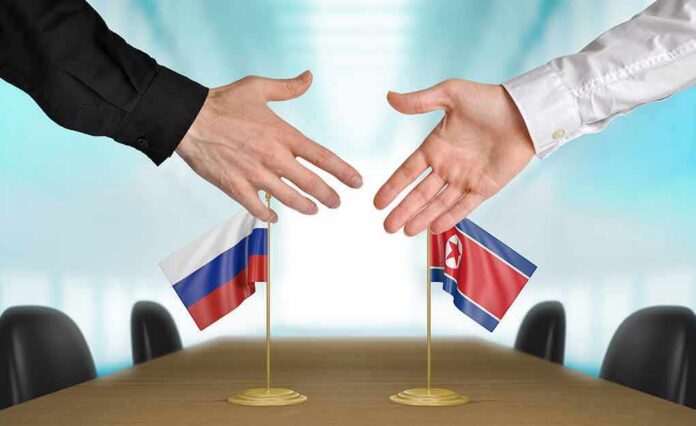
Russia’s open praise for North Korean troops in the Kursk fighting shows how fast two nuclear-armed dictatorships are turning quiet military cooperation into a formal war partnership that worries people across the political spectrum.
Story Snapshot
- Putin met North Korea’s foreign minister at the Kremlin and thanked Pyongyang for direct military support in his war on Ukraine.
- North Korean soldiers helped Russia push back a major Ukrainian assault in Russia’s Kursk region under a mutual defense pact between the two regimes.
- Western and South Korean officials say North Korea has sent thousands of troops and large amounts of artillery and missiles, while Moscow and Pyongyang stay vague on numbers.
- The deepening Russia–North Korea alliance fits a wider pattern of authoritarian states backing each other in ways that bypass normal accountability and fuel global tension.
Putin’s Kremlin Meeting with North Korea’s Top Diplomat
Russian President Vladimir Putin met North Korean Foreign Minister Choe Son-hui at the Kremlin, in another sign that the two countries’ ties are tightening. Russian and North Korean reports say Putin thanked North Korea for supporting his “special military operation” against Ukraine, and praised what he called strong bilateral relations. Choe’s trip continues a series of high-level visits between Moscow and Pyongyang after both sides signed a strategic partnership earlier, which pledged mutual military support if either claimed to face aggression.
North Korean state media and Russian outlets both framed the meeting as proof that the relationship is “developing as planned,” with talks covering military and political cooperation. Choe also met Russian Foreign Minister Sergei Lavrov and said North Korea would stand with Russia “until the day of victory” in Ukraine, signaling long-term support rather than a short, one-time deployment. For average Americans watching from afar, this looks less like routine diplomacy and more like the open buildout of an anti-West military bloc that does not answer to any voters.
North Korean Troops and Weapons in the Kursk Fighting
Russian and international reports now say North Korean troops helped Russia repel a large Ukrainian incursion into Russia’s western Kursk region in 2024. Under the mutual defense pact, North Korea sent roughly fourteen thousand soldiers to fight alongside Russian forces in Kursk, according to a detailed account of the campaign. Western officials earlier estimated around ten thousand North Korean troops in Russia, with most stationed in the Kursk area, and they accuse Pyongyang of shipping millions of artillery shells and ballistic missiles to fuel Russia’s war machine.
North Korea long denied sending troops, but later publicly acknowledged that its military took part in the conflict and claimed its soldiers helped Russia retake the “strategically important” Kursk region after a Ukrainian counterattack. Russia, for its part, still avoids giving hard numbers, but Putin has gone out of his way to praise what he calls the “heroic deeds” of North Korean personnel who received Russian state awards. For many Americans who already feel their own leaders hide the full costs of foreign wars, this secretive deployment of foreign troops in Russian uniforms is a reminder of how little transparency ordinary people get from powerful governments.
Why Authoritarian Military Pacts Matter for Ordinary Citizens
Experts who study authoritarian regimes say this kind of military deal is now a common tactic: dictators trade soldiers, weapons, and technology to keep each other in power, while avoiding clear evidence that could trigger global punishment. Russia gains manpower, ammunition, and fresh artillery for a draining war, while North Korea gets badly needed food, energy supplies, and advanced military know-how that can strengthen its missile and nuclear programs. This “you help my war, I help your regime survive” logic works for Putin and Kim Jong Un, but it raises the risk of wider conflict for everyone else.
Research on “authoritarian sponsorship” shows outside support often makes repressive governments more durable and less accountable to their own people. As Russia and North Korea deepen their partnership, they also test how much the United States, Europe, and allies will tolerate before responding with more sanctions, weapons shipments, or troop moves of their own. Americans on both the right and the left already worry that global power games like this end up costing taxpayers more money, raising energy prices, and pulling the country into new military commitments while the federal government still struggles to fix problems at home.
Information Gaps, Media Spin, and Growing Public Distrust
The fight over how many North Korean troops are in Russia shows another problem: regular citizens must rely on intelligence leaks and media framing, not clear proof they can check themselves. Western outlets repeat government estimates and talk about “growing concern,” while Russia and North Korea stress friendship and gratitude but avoid confirming numbers or roles. This gap leaves people stuck between state-run narratives and anonymous sources, which is exactly the kind of information warfare that makes many Americans feel manipulated by elites.
Russian President Vladimir Putin met North Korean Foreign Minister Choe Son Hui in Moscow and thanked North Korea for backing Russia's war in Ukraine. Choe reaffirmed Kim Jong Un's commitment to strengthening ties with Russia during the Kremlin meeting.
The visit has drawn… pic.twitter.com/uL05vPQAZl— India Today Global (@ITGGlobal) July 21, 2026
Scholars warn that as more authoritarian states link up, legal and public checks on their use of force get weaker, making it harder to hold anyone accountable for sending foreign troops into secret battles. At the same time, citizens in democratic countries see their own governments respond with bigger defense budgets and new deployments, often decided behind closed doors. In that sense, Putin’s warm welcome for North Korea’s foreign minister is not just about Russia and Ukraine; it is another reminder that ordinary people across the world, including in the United States, are watching powerful leaders make high-stakes war decisions with very little say.
Sources:
military.com, aa.com.tr, scmp.com, reuters.com, themoscowtimes.com, internazionale.it, anews.com.tr, en.kremlin.ru, yahoo.com, youtube.com, sfgate.com, upi.com, gupea.ub.gu.se