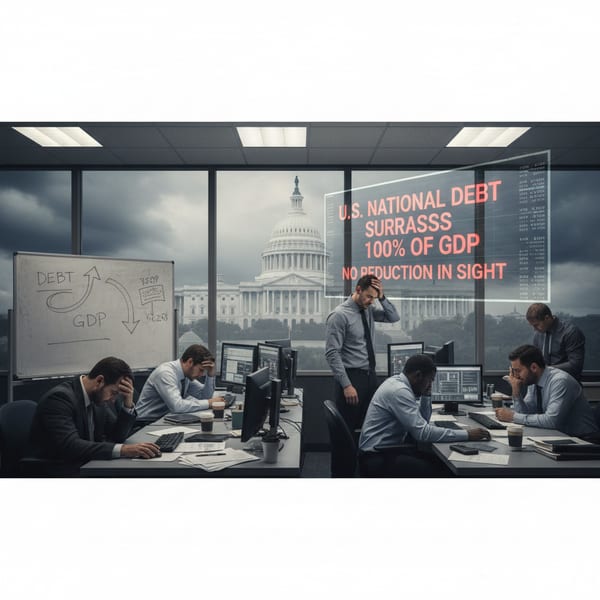
The United States has crossed a financial threshold not seen since World War II: the national debt now exceeds the entire size of the American economy, with no credible plan in place to reverse the dangerous trajectory.
Historic Milestone Signals Fiscal Crisis
Federal debt held by the public reached approximately $31.3 trillion as of March 31, narrowly surpassing the nation’s annual GDP of roughly $31.2 trillion. This pushes the debt-to-GDP ratio just above 100 percent for the first time in nearly eight decades. The government currently operates at a staggering deficit, spending $1.33 for every dollar collected in revenue. Analysts project this year’s deficit alone will hit $1.9 trillion, fueling concerns about long-term economic stability and the burden being placed on future generations.

Interest Payments Consuming Federal Budget
One of the most alarming consequences involves interest payments on the mounting debt. Approximately one in every seven federal dollars now goes solely to servicing debt interest, a proportion expected to climb if rates increase. Unlike temporary spikes during emergencies like the pandemic, current debt levels stem from structural problems: escalating costs for Social Security and Medicare combined with reduced tax revenues following recent cuts. The Congressional Budget Office warns debt could balloon to 120 percent of GDP within ten years, climbing even higher without genuine reform.
Bipartisan Failure and Economic Consequences
Maya MacGuineas, president of the Committee for a Responsible Federal Budget, characterized the crisis as a “total bipartisan abdication of making hard choices.” She warned that rising debt slows income growth, pushes up interest rates, and increases inflationary pressures while massive interest costs squeeze budgets. The U.S. benefits from the dollar’s reserve currency status, making borrowing easier than for most nations. However, economists caution this advantage could evaporate if confidence erodes. Potential consequences include surging borrowing costs, higher inflation, a weaker dollar, and reduced investment. In a worst-case scenario, loss of confidence could trigger market instability and force painful choices between spending cuts, tax increases, or continued borrowing. Stabilizing the situation requires spending restraint, higher revenues, or stronger economic growth—decisions politicians from both parties have avoided for years.