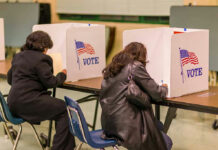
House Republicans moved one step closer to making proof of citizenship a gatekeeper for federal voting, then hit a wall when the fight shifted to the Senate and the defense bill route. The vote showed how far the issue has already gone, and how deeply it still divides Washington.
Quick Take
- The House Rules Committee advanced a plan to attach the SAVE America Act to the National Defense Authorization Act.
- The House had already passed the SAVE America Act earlier in 2026 on a 218-213 vote.
- The bill would require documentary proof of United States citizenship to register for federal elections and photo identification to vote.
- Supporters frame the measure as election security, while opponents warn it could block eligible voters from registering.
House Leaders Try a New Path
The House Rules Committee advanced a rule to merge the SAVE America Act with the National Defense Authorization Act, a major defense bill that usually must pass. The move was meant to keep the voting bill alive after earlier resistance in the Senate. House Republicans then faced another setback when the procedural vote failed, showing that even some members of their own party were unwilling to move the package forward.
The SAVE America Act itself is not a vague proposal. The House bill text says it would amend the National Voter Registration Act of 1993 and require documentary proof of United States citizenship to register for federal elections. The bill also defines which papers count, including a passport, certain military records, a government photo identification showing birth in the United States, or other proof tied to citizenship or naturalization.
What the Bill Would Change
Under the bill, a person registering by mail would have to deliver citizenship papers in person to an election office. The measure would also require photo identification at the polls, which makes it broader than earlier versions that focused mainly on registration. Supporters say that adds a new barrier against illegal voting. Critics say it creates a new barrier for eligible voters who do not have easy access to the right documents.
The bill also creates a special path for people who cannot produce standard proof right away. In those cases, a state or local official can sign an affidavit saying the person has shown enough evidence of citizenship. That detail matters because even supporters acknowledge that not every eligible voter will walk in with a passport or birth certificate in hand.
The Political Fight Around It
Political coverage of the bill shows a split that goes beyond party labels. Supporters argue the measure enforces citizenship rules that already exist in federal law. Opponents, including voting rights groups and Democrats, warn it could disenfranchise millions of eligible Americans. The dispute is not just about fraud. It is also about who bears the burden when the government asks people to prove they belong.
House once again votes a BILL to Vote on THE SAVE AMERICA ACT attached to NDAA. Trying a different approach now. Onto the Senate another way. Hopefully Thune can reason with Elizabeth MacDonough the Parliamentarian! If not he should fire her just like President Trump requested.
— Live2write (@Live2write1) July 15, 2026
The latest fight also exposes a larger problem in Washington: procedure often matters more than policy. Instead of a direct floor vote on election rules, House leaders tried to attach the measure to must-pass defense legislation. That tactic reflects a Congress that struggles to settle major issues on the merits. It also feeds the public view, held across the political spectrum, that leaders are more focused on leverage than on clean lawmaking.
Why the Stakes Remain High
Even after House passage, the bill still faced a hard road in the Senate because of the filibuster threshold. News reports said Republicans did not have enough support to clear that hurdle. The result leaves the SAVE America Act in a familiar place for this kind of legislation: approved in one chamber, blocked in the other, and turned into a symbol for a much larger fight over election trust, voter access, and the limits of federal power.
That broader fight is what makes the story matter. Backers see a simple safeguard. Critics see a federal system that asks too much of ordinary voters while doing too little to solve real problems. Both sides are reacting to a public mood shaped by distrust of elites and frustration with government that seems to spend more energy on political combat than on workable solutions.
Sources:
thegatewaypundit.com, congress.gov, cnbc.com, bipartisanpolicy.org, cbsnews.com, democrats-cha.house.gov, ncsl.org, ballotpedia.org, warnock.senate.gov, responsivegov.org, lwv.org, theregreview.org, brennancenter.org, whitehouse.gov, michigan.gov, aclu.org, usmayors.org, aljazeera.com, cnn.com, naacpldf.org, issueone.org, voteriders.org, americanprogress.org, facebook.com, lawyerscommittee.org, fairelectionscenter.org, everycrsreport.com, mapresearch.org, npr.org, rockthevote.org